
The National Bank raised the refinancing rate by 1.5 pp up to 16%. This indicates significant inflationary expectations in NBU and its readiness to ensure financial stability in the country during the election campaign.
Last increase in the refinancing rate became the third one within last months: on October 27, 2017, the NBU raised its discount rate from 12.5% to 13.5%. In December 2017, the National Bank raised its refinancing rate from 13.5% to 14.5%.
Such an increase in refinancing rate has become to a large extent a surprise for the market. Neither experts nor profile journalists could foresee such an increase.
The size of the refinancing rate directly affects the amount of money in circulation and the price for loans provided by the National Bank to commercial banks. The higher it is, the more expensive the banks loans are, the more expensive they offer their own loans. Accordingly, subject to high interest rates, economic agents rarely take loans and, accordingly, reduce the demand for goods and services that are often purchased on credit. Accordingly, producers refrain from increasing production and rising prices due to low demand. Usually this leads to a reduction in the GDP growth.
The market reacted quickly enough – the weighted average cost of loans on the interbank market increased by 1.1 pp up to 15.1% per annum in the first five days after raising the refinancing rate. We expect growth to continue to reach 18%. Also, the rates on government bonds will increase, thus it will more expensive for government to make borrowings on the domestic market. This may reduce the Cabinet of Ministers’ ability to increase social security payments.
Such actions of the regulator testify to the following:
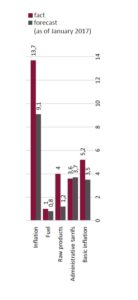
- The NBU expects inflationary pressures to increase. The NBU forecasts that inflation in 2018 will be 8.9% but there are reasons to believe that the actual inflation rate this year will reach double-digit rates, as in the past year. Last year, the inflation rate went up with the regulator’s forecast by 4.6 pp: 13.7 versus 9.1%.
The key factors that determine the dynamics of inflation in 2018 will be the further growth of administrative tariffs, the growth of prices on foreign markets, the possible increase of social payments (in the first place – minimum wages), as well as significant devaluation expectations as well as the need to pay off external debt.
- By raising the refinancing rate, the NBU demonstrated its independence from political influence and willingness to provide financial stability in the country that enters the election season. Moreover, by its decision, the National Bank once again demonstrated to the market and other state bodies that the fight against inflation is a higher priority for it than economic growth. As a result, the negative reaction of the Government and individual politicians was immediate. Prime Minister Groysman said during the government meeting that it is necessary to reduce the refinancing rate on loans, because they should be available for the economy. In addition, NBUs decision was criticized by Oleg Lyashko.
- An increase in the refinancing rate will negatively affect the GDP growth rate of Ukraine. If the NBU focuses on the economic growth at 3.4% (slightly above the previous forecast of 3.2%) in 2018, it expects a slowing down to 2.9% in the next two years.
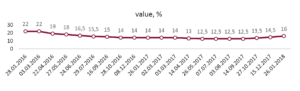
The next revision of the refinancing rate will be in spring. One of the key factors influencing the decision of the NBU will be the probability of receiving the next tranche from the IMF. However, the NBU is ready to continue raising its refinancing rate if inflationary pressure does not decrease, divergences with the IMF continue, and the government’s course to increase social standards goes on.