
The Kremlin argues its critics are insane
The Russian government’s last line of defense against its critics is that they are mentally unstable. Sometimes, this is its only line of defense.
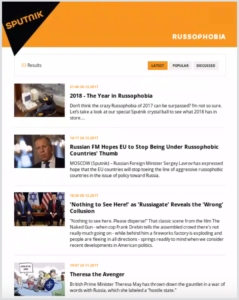 Since Russia annexed Crimea in March 2014 in a move that a wide majority of the international community rejected as illegal, the Kremlin has tried to justify the move by calling its opponents “Russophobes.” As Russia’s interference in the U.S. presidential election in 2016 was exposed, Russian government officials began to accuse their critics of “anti-Russia hysteria.”
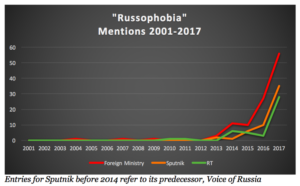
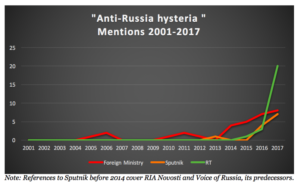
These accusations of mental instability are not random. @DFRLab tallied the use of the two terms by the Russian Foreign Ministry, and by Russian state propaganda outlets, since 2001.
Official uses of “Russophobia” exploded after the Crimean annexation in March 2014. Initially used to justify the annexation, the term was subsequently used to attack foreign critics of the Russian government, including those who imposed sanctions on Russia, especially Canada, the European Union, and U.S. Congress.
“Anti-Russia hysteria” took off later, surging in 2017. It was mainly used to describe the reaction to Russia’s interference in the U.S. elections, often in connection with terms such as “witch hunt” and “McCarthyism.” It was especially used by RT.
These attacks fit within the Kremlin’s broader response pattern of “dismiss, distort, distract, dismay.” However, the decision to call its critics mad suggests that the Russian government finds it hard to prove them wrong. To say that a critic is critical only because they have a phobia is a last-ditch argument which betrays the fundamental weakness of the Kremlin’s position.
Russophobia before 2014“Russophobia” — the irrational fear or hatred of Russia or Russians — barely featured in Russian official statements before 2014. According to a search for the term “Russophob” (to encapsulate the variants “Russophobia,” “Russophobe” and “Russophobic”) on the English-language version of the Foreign Ministry’s website, it was only used six times from 2001 to the end of 2013. RT, the Russian government’s “information weapon,” added two more.
Early use of the term concerned disputes between Russia and its neighbors. Latvia was the target in 2004 after it expelled a Russian diplomat, Ukraine in 2007 and 2009, and unspecified former-Soviet states in 2011. The underlying theme in the latter cases was whether the Red Army of 1944–45 should be viewed as a liberating or occupying force. Criticism of the Red Army is an exceptionally sensitive point in Russia, viewed with a quasi-religious fervor; the Foreign Ministry has often referred to critics of the Red Army as “blasphemous”.
Later use of the term, however, focused on accusations of corruption, crime, and human rights violations. In 2010, RT headlined an article on the extradition of suspected Russian arms dealer Viktor Bout to the United States as “Russophobia”. The word only appeared in the headline, not the article; it can only, therefore, have been an editorial insertion by RT.